
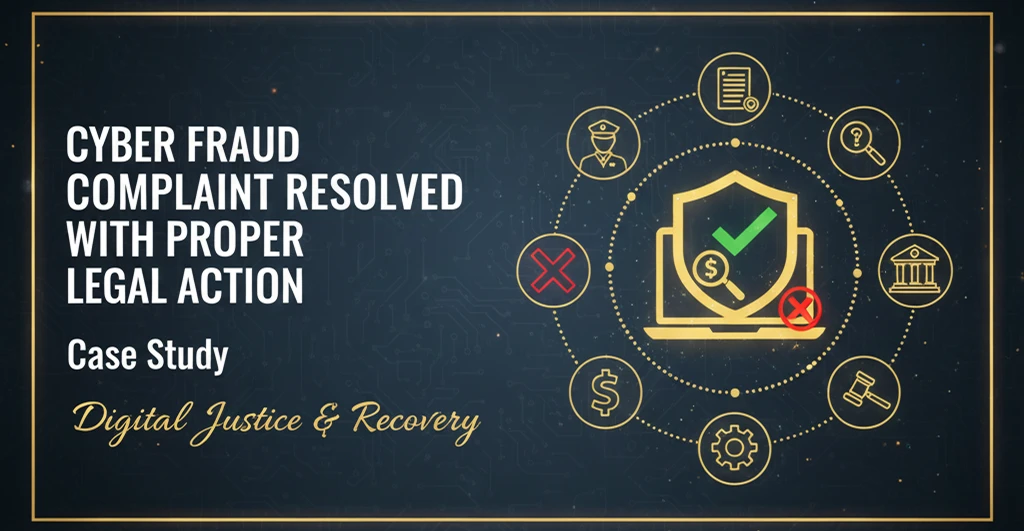
Cyber fraud has become increasingly common in India, affecting individuals and businesses through phishing, OTP fraud, online payment scams, identity theft, and digital impersonation. In this case, our client fell victim to an online payment scam in which a fraudster impersonated a verified service provider and induced the client to transfer a significant amount of money through UPI.
When the client realised the fraud, they were confused about the next steps and approached us for immediate assistance. Understanding the urgency, our team acted promptly to secure digital evidence, file a cyber complaint, and initiate legal and procedural steps to prevent further financial loss.
We ensured that every step—right from drafting the complaint to coordinating with Cyber Crime Cell, banks, financial intermediaries, and law enforcement—was handled professionally and within the correct legal framework. Using provisions under the Information Technology Act, 2000, IPC sections relating to cheating, impersonation, and fraud, and RBI’s UPI dispute guidelines, we ensured that the complaint received fast attention and proper action.
Through consistent follow-up, timely submission of evidence, and effective communication with the authorities, the cyber fraud complaint was successfully resolved. The client recovered the lost funds, and investigation was initiated against the fraudster, ensuring accountability.
This case involved several complex challenges typical in cyber fraud matters:
The client lost money instantly via UPI transfer, requiring urgent intervention to freeze the fraudulent account.
Screenshots, chat logs, transaction IDs, call recordings, and bank statements had to be collected and preserved properly.
Fraudsters often quickly transfer money across multiple accounts, so fast action was essential to trace and stop the flow.
Cyber fraud often involves cross-state or unknown locations, requiring coordination with multiple authorities.
The client approached us several hours after the fraud, making timely action critical.
The complainant had limited knowledge of cybercrime processes, requiring clear guidance and support.
A detailed and legally structured cyber complaint was necessary to ensure swift police action.
Each challenge required technical understanding, legal expertise, and effective communication.
Our team executed a strategic, multi-step solution tailored for cyber fraud cases:
We guided the client to preserve all digital records:
WhatsApp/Telegram chats
Fraudulent links
Screenshots
UPI transaction IDs
Call logs
Bank statements
Account numbers involved
A detailed complaint was drafted and filed under appropriate sections of:
Information Technology Act, 2000
IPC Sections 419, 420, 468, 471 (cheating, impersonation, fraud)
We also flagged the urgency to increase priority.
We personally followed up with:
Local Cyber Police Station
Financial institutions
Fraud investigation teams
Nodal officers of banks and payment apps
Using RBI guidelines, we submitted an immediate request to freeze funds in the beneficiary account.
We helped the client prepare:
A factual statement
Transaction explanation
Identity verification documents
A timeline of the fraud
Technical details of the scam
Where required, we issued notices to expedite freezing and reversal procedures.
We provided full cooperation and guidance during police interrogation and evidence review.
Regular follow-up ensured the matter did not get delayed within the system, speeding up recovery.
The outcome of the case was highly successful:
The fraudulent UPI transfer amount was refunded to the client after the account freeze and investigation.
A formal FIR was lodged under relevant sections of IPC and IT Act, enabling legal action against the fraudster.
The fraudulent bank account was identified, flagged, and blocked to prevent further scams.
Because of a well-drafted complaint, police took immediate action.
Our structured documentation helped authorities establish the fraud clearly.
With funds restored and action taken, the client felt protected and legally empowered.
The client also implemented cybersecurity best practices to prevent future incidents.
A highly contested child custody dispute was resolved in favour of our client through a strategic evidence-based legal approach, highlighting the chil...
Read More
A complex and high-risk criminal case resulted in the successful granting of bail through strong legal arguments, strategic evidence presentation, and...
Read More
A complex commercial contract dispute between two major Indian businesses resolved successfully through strategic negotiation and litigation, safeguar...
Read More
Our legal team successfully filed and presented a High Court appeal backed by strong legal grounds, procedural accuracy, and persuasive arguments. The...
Read More
A mutually agreed divorce between a couple was finalized in the shortest legally possible time through precise documentation, strategic planning, and ...
Read More
A false cheque bounce case filed under Section 138 of the Negotiable Instruments Act was successfully defended by demonstrating lack of legally enforc...
Read More
A major consumer dispute was successfully resolved when our legal team proved that the service provider delivered a defective product and failed to re...
Read More
Our legal team successfully defended a client falsely accused of criminal defamation under Sections 499 and 500 of the Indian Penal Code (IPC). Throug...
Read More
A long-standing and highly complicated land ownership dispute involving multiple stakeholders, contradictory documents, and decades-old records was su...
Read More
A complex property dispute that spanned over a decade, resolved successfully through meticulous legal strategy, setting a precedent for property title...
Read More